Usually this question is asked by the atheist or agnostic who doubts the existence of God on the basis that the question cannot be answered. To phrase the question another way, “If God was the beginning who began God?” I think it is an illogical question for a number of reasons:-
1. The Universe must have a beginning
The Universe had a beginning. The laws of thermodynamics show it is running down and it cannot have been running down forever or it would have already run down! No stars would be still churning out energy and we would not be here. One of the most established principles of logic is the principle of causality: something that has a beginning has a sufficient cause. Today’s atheists like to use words like “rational”, “reasonable” and “scientific” in describing their beliefs Yet they seem to believe that the greatest beginning of all has no cause whatsoever!
Some have proposed one universe giving birth to another, but again, there cannot be an infinite series of such births and deaths, as each cycle must have less energy available than the last and if this had been happening for eternity, the death of everything would have already happened. It makes more sense to say that God has always existed and is Himself God. His existence had no beginning and will have no ending. He always was, always is and always will be God. It is impossible to explain where God came from!
2. The cause of the Universe
The cause of the universe must have been non-material because if the cause was material/natural, it would be subject to the same laws of decay as the universe. That means it would have to have a beginning itself and you have the same problem of cycles of births and deaths of universes. So the cause of the universe’s beginning must have been super-natural, i.e. non-material or spirit. It is a cause outside of space-matter-time. Such a cause would not be subject to the law of decay and so would not have a beginning. The cause had to be eternal spirit.
Furthermore, the cause of the universe had to be incredibly powerful; the sheer size and energy seen in the universe together speak of that power; there had to be a sufficient cause. That sounds like the God of the Bible to me. The Bible reveals the Creator of the universe as:
- Eternal – See Psalm 90:22 – “Before the mountains were brought forth, or ever you had formed the earth and the world, from everlasting to everlasting you are God.” God does not fit into our limitations of time. See Genesis 1:1. God created time and is therefore outside its influence. God is eternal.
- All-powerful – See 1 Chronicles 29:11-12. “Yours, O LORD, is the greatness and the power and the glory and the victory and the majesty, for all that is in the heavens and in the earth is yours. Yours is the kingdom, O LORD, and you are exalted as head above all. Both riches and honour come from you, and you rule over all. In your hand are power and might, and in your hand it is to make great and to give strength to all.” God knows and controls all things. He is the creator not the creation.
- Spirit (non-material) – See John 4:24. “God is spirit, and those who worship Him must worship in spirit and truth”. The laws of the physical universe have no effect on God.
To ask where someone who is eternal, someone who had no beginning, “where did you come from” is like asking, ‘To whom is the bachelor married?’ It is an irrational question. The Bible matches reality, which is not surprising when we consider that it claims to be from the Creator Himself.
3. The purpose of life itself
Those who reject the eternal Creator not only have to believe that matter came into being without any cause but also have to believe that life itself popped into existence without an adequate cause.
Even the simplest single-celled life is incredibly complex. See http://www.journeyinsidethecell.com/ for example. A so-called “simple” bacterium is full of incredibly sophisticated nano-machines that it needs to live. A cell needs a minimum of over 400 different proteins to make the machines that are absolutely essential for life. How could these protein-based machines make themselves, even if all the right ingredients (20 different amino acids, but many of each) could make themselves? The amino acids, often thousands of them, have to be joined together in the correct order for each protein to function. We marvel at the scientists who are discovering the nano-technology in living things—and it is an astonishing enterprise. But what of the One who invented these things? How much more intelligent is He?
It’s no wonder that Richard Dawkins admits that scientists might never work out how life could arise by natural processes and yet he rejects the creation explanation. We know sufficient about the Creator from His creation to be “without excuse”. See Romans 1:18-22. The Bible also explains why otherwise intelligent people choose to believe impossible thing like that the universe and then life, just popped into existence without any adequate cause. They choose the illogical rather than acknowledge and honour their Creator. I like this quote “The atheist can’t find God for the same reason that a thief can’t find a policeman.” God is not trying to keep His existence a secret!
Categories: Apologetics
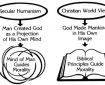 Christian Reply To Secular Humanism – Colossians 2:8
  Feed My Sheep
Hi-
Yes, the question “who created God’? is just about the dumbest question ever.
It belies a befuddled understanding of the Cosmological argument and concedes that the universe exists along a chain of causal factors where certain events (x) lead to other events (y). The atheist who offers such a ridiculous question has concede to the following premise.
P1 A *chain* of causation must be finite. Notice, the atheist who offers the query “Who made God?” is acknowledging that causation exists as a chain and is simply attempting to inquire as to the origins of the first cause. Symbolically we could represent this in this manner: Here is a list of causes beginning with the first cause (x1). X1->X2->X3. Suppose this is my argument X1 caused X2 which caused X3 to wit the Atheist replies “I agree that X2 and X3 have a cause but what caused X1?
X1 is uncaused. Doesn’t this seem irrational? No, in fact the theistic position is much more reasonable than the atheistic one. X1 is not a finite effect. Every contigent existent has a cause and is an effect of prior causation. The first cause, in this example X1 is a Necessary *Cause* and is not bound up in contigency. The chain of causation begins with a necessary being that is not the effect of prior causation. The atheistic position posits an uncaused cause that is neither contigent nor necessary.