1. Past Covenants in God’s Revelation
God has already made several agreements with mankind:
- The Adamic Covenant: God made Adam the caretaker of the Garden of Eden and he was given authority over the animals and land. He was given specific instructions but disobeyed and sin and death entered. God promises a deliverer in the eed of the woman. (Genesis 2-3).
- The Noahic Covenant: God promises never to destroy creation again by a flood (Genesis 9:8-11).
- The Abrahamic Covenant: God promises to bless Abraham and his descendants and make them a great nation (Genesis 12:1-7)
The Mosaic Covenant is a new conditional covenant made between God and the nation of Israel at Mount Sinai (Exodus 19-24). It is different in that it is conditional, and the blessings that God promises are directly related to Israel’s obedience to the Mosaic Law.
2. Why were they in Egypt?
We know in Genesis the practical reason the Hebrews went into Egypt, but what spiritual reasons did God have for fulfilling his promise that they would multiply into a nation and have their own land?
- God planted them there as an “incubator” to grow their numbers before entering the Promised Land.
- Waiting for the iniquity of the land’s inhabitants to become “full”. Genesis 15:12-16. God showed patience and mercy towards the Amorites but now their time was running out. The Israelites returned to the promised land, but the Amorites were destroyed as the Lord predicted (Numbers 21:31-32; Joshua 10:10; 11:8).
- When the Israelites left Egypt following the tenth plague, they were told to ask the Egyptians for items of value for their journey. “The people of Israel . . . asked the Egyptians for silver and gold jewellery and for clothing. And the LORD had given the people favour in the sight of the Egyptians, so that they let them have what they asked. Exodus 12:35-36). This would be important later and compensation for years of unpaid labour.
3. Israel – One who struggles with God (1:1-7)
The word Israel means “one who struggles with God”. Jacob and Israel were sojourners into Egypt. They were foreigners and strangers in a strange land. They came into the land under the protection of Joseph, a chief Vizier to Pharoah. We read in Genesis 46 that Jacob goes to Egypt with all his family to escape the drought and follow the word of God to go there.
In Genesis 10 we are given 70 founders of the nations of the world or racial groups. They are all divided into 3 primary classifications: Shem, Ham, and Japheth. Although the classification of nations and the origin of languages is highly controversial, ethnologists agree on one key point: that all of mankind can be divided into three basic groups.
Jacob’s sons and family were 70 in number when they came to Egypt through the protection of Joseph. They are a kind of microcosm within Egypt of the all the nations of the world.
4. A New Pharaoh (1:8)
The descendants of Jacob multiply whilst in Egypt but then “A new king arose over Egypt who did not know Joseph”, The identity of the stranger is that which does not fit with your identity , that is not your friend and outside of you. The relationship with he stranger has to be the proper one because there is a danger, if you are not careful, that the stranger will take your potential or identity from you. This is what happens in war and those that win can reduce your potential. Women are important as they are the ones who bear the children and will increase your potential. You can have a proper relationship but if the Pharaoh forgets you then there is a danger as strangers will be reduced in order to serve the function of the Pharaoh.
In the book of Genesis, Joseph saved the Egyptians from famine but in doing so they had to give up all of their land to Pharaoh and give up one-fifth of all their production to Pharaoh. In saving the people, Joseph centralised the power of the State. Joseph was part of what created the Tyrant and when the new Pharaoh forgets Joseph, he turns upon the Israelites. Once power is centralised and it forgets you, then you will fall under the thumb of that power. It was a side effect of saving Egypt and Israel at the time. This is perhaps the dark aspect of Joseph in centralising the power of the Pharaoh.
Joseph and Jacob die, and generations pass and the relationship between the Egyptians and the Israelites becomes strained. This verse summarises the unregenerate human condition of ingratitude perfectly. Joseph had saved millions of Egyptians from starvation and a future Pharaoh doesn’t even know his name. It is generally thought this new king was from a different dynasty. It is also unclear how much time has passed. Regardless, they have forgotten the debt they owe Joseph’s family.
5. Pharoah vs God (1:9-10)
Egypt is the land of the pyramids. There is an order to things that lead to it becoming a great nation but will eventually lead to its tyranny and eventual downfall.
The main “gods” of Egypt are below where you can see the “family” tree starting with Atum-Ra. He is called the first king of Egypt; thus, it was believed that the Pharaohs were his descendants and successors. His worship increased massively in the Fifth Dynasty, when Ra became a state-deity and pharaohs had specially aligned pyramids, obelisks, and sun temples built in his honour.
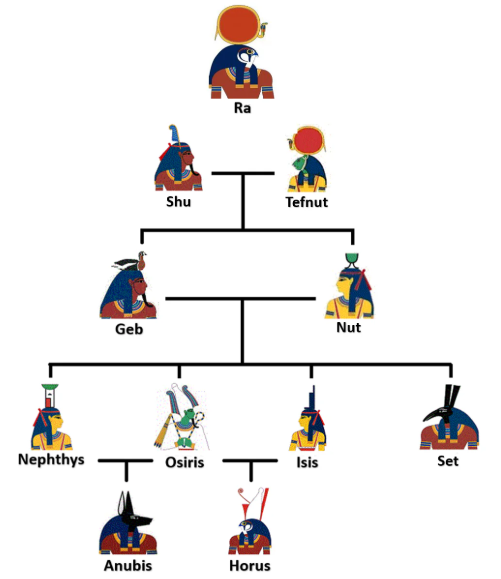
https://egyptian-history.com/en-uk/blogs/egyptian-gods/egyptian-gods
The word “Pharaoh” means “great house” in Egyptian. Pharaohs were looked upon as more than rulers. They were “gods” chosen to lead the people and maintain order and provided an important link between the Egyptian people and their gods.
Pharaoh owned all the land in Egypt, enacted laws, collected taxes, and served as commander-in-chief of the military. Religiously, the king officiated over religious ceremonies and chose the sites of new temples. Ancient Egyptian Society saw the Pharaoh essentially as “god on earth” and would live on as a god in the afterlife.
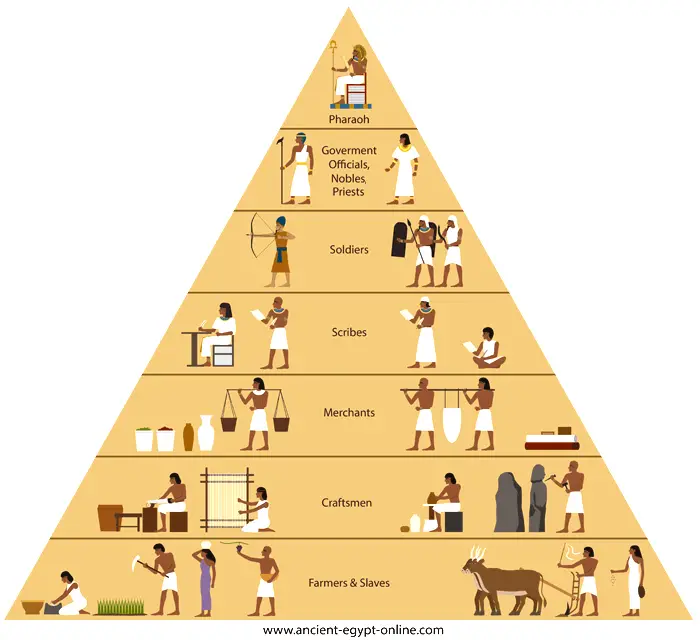
From this hierarchy, we can see that Joseph would have been a Vizier and second only to Pharaoh as the Bible tells us. In Ancient Egypt the midwife would have been a servant for the wealthier classes and a family/friend for those that were poorer.
The gods of Egypt will be exposed as false gods in the battle that Moses faces with Pharaoh to release the Israelites. Each of the plagues is against one (or more) gods of Egypt who are powerless against the God of the Israelites.
6. Reducing People’s Potential to Bricks (1:11-14)
Pharaoh wants to reduce Israel to the potential to be used by Egypt. Later he will try and get rid of the men to reduce their population and more easily control them.
The story of Abraham, Sarah and Pharoah in Genesis 12:10–20 is a foreshadowing of where Pharaoh wants to take his wife to be his own. This is again to take the potential of the people to subjugate it under a tyrant. Abraham deceived Pharoah that Sarah was his sister. When Pharaoh finds out he is angry but doesn’t force the issue. However, the Pharaoh of Egypt in Exodus is a far worse tyrant.
Egypt represents our own passions. When we become a slave to something we become an instrument to that thing. It is like a drug addict who serves the tyrant, and all their potential gets reduced or lost.
The making of bricks is also a reference back to Babel in Genesis 11:3 – They said to each other, “Come, let’s make bricks and bake them thoroughly.” They used brick instead of stone, and tar for mortar. There is still this idea of man wanting to be higher than God or replacing God.
| Bricks | Stones |
| They are man-made, artificial rocks. You will not find a brick occurring in nature. They are identical and uniform. It is hard to distinguish one brick from another. They are functionally interchangeable. A brick can serve equally well anywhere in a wall. | They were created by God not man. They are unique in shape, size, strength, and purpose. They are not interchangeable. When building roads or walls, you need to find the unique stone and/or style of rock for the job. |
Table: Comparing Bricks to Stones
The bricks are where we build a civilisation which we think can replace the highest ideal. It is a man-made religion and secularism. Similar to the Tower of Babel, Pharoah used slaves for his building projects – the treasure cities of Pithom and Ramses.
This can be compared with 1 Peter 2:4–5 where God is looking for living stones to be built up as a spiritual house. God is not looking for uniform bricks. He gives different spiritual gifts through His Holy Spirit. See Romans 12:6-8.
Categories: Exodus, Uncategorized
 Feed My Sheep
Leave a Reply!