The Da Vinci Code is not based in history. It filled with misrepresentations, errors and plain fantasy which is paraded as fact. The author’s agenda is a direct attempt attack on Jesus, the Church and those who follow Him. We learn that Christianity was invented to suppress women and turn people away from goddess worship. The heart of the book is that Jesus was married to Mary Magdalene and they had children. They then went to France and established the French royalty. There has been a conspiracy to cover this up over the centuries. The church has been using male leadership in the church to suppress women. Here are six areas to suggest that the Jesus of the Da Vinci code is pure fantasy.
1 – History
History is supposed to find facts. Today people are looking at history with their own bias. The Da Vinci Code is a fantasy based on no historical facts.
2 – Jesus Christ never claimed to be divine and was never worshipped as a deity until the Council of Nicaea in 325 A.D.
The only fact is that the Council of Nicaea did take place in 325 A.D. Constantine did not create the belief that Jesus was divine. The council met because there was heretics who were denying the divinity of Jesus Christ. They had a vote on the divinity of Christ which the book claims was a close. In fact only two of the three hundred bishops refused to sign. It was not exactly a cliffhanger.
The New Testament was already agreed upon at that time. There was still one or two books still being discussed. The Council of Nicea did not have eighty books to consider.
3 – The Gnostic gospels give a more accurate account of the life of Jesus than the Canonical gospels
The Gnostics believed that God would never become a man. They believed that all matter was evil. There was no need for forgiveness but rather self realisation. They tried to give their writings credence by giving them the names of some of the Apostles. E.g. Thomas and Philip. The Gnostic gospels have been dated from 150 AD at the earliest and most from the 3rd to the 6th century AD. Do you believe the credibility of someone who was an eye-witness or someone who speculates a century or more later? The Gnostic gospels are not only unhistorical but also anti-historical. When you read these Gnostic gospels you also realise that they don’t sound like Jesus. For example:-
Jesus said to them, “When you make the two into one, and when you make the inner like the outer and the outer like the inner, and the upper like the lower, and when you make male and female into a single one, so that the male will not be male nor the female be female, when you make eyes in place of an eye, a hand in place of a hand, a foot in place of a foot, an image in place of an image, then you will enter [the kingdom].” Gospel of Thomas vs 22.
4 – The marriage of Jesus to Mary Magdalene is a matter of historical fact
A lot is read into the painting of the Last Supper by Da Vinci. Most historians do not believe that Mary is in the picture. It may be an effeminate looking John the disciple but that is the way Da Vinci painted. He did the same with his picture of John the Baptist. The fact that there is no cup is not surprising. He is painting based on John’s Gospel. There are other paintings which also do not have the cup.
The Gospel of Philip has risen to claims that Jesus kissed Mary in the mouth. How credible is this book? It has been dated to the 3rd century. It is 200-300 years after the events. The book is full of pagan philosophy. It is not a credible historical witness. Unless you want to believe it to reject Jesus.
There is a very good reason why Jesus could not have married. He is engaged to be married to his Church. The marriage supper of the Lamb is an event that will happen in the future. Jesus will be married then. His bride will be the Church. In the Da Vinci code blasphemy is delivered in a soft voice with a knowing chuckle.
5 – Luke the Historian
See Luke 1:1-4. Luke put together an investigation so as to give a historical account. He was a doctor and pays attention to detail in the Gospel of Luke and the Acts of the Apostles. To him it was the most important task of his life.
Luke travelled with Paul. Paul would be Luke’s chief source of information, and Luke’s travels would have given him opportunity to make personal contact with many of the church leaders throughout Judea and the Roman empire. He could have obtained all the data he needed for his history from personal contacts and personal journals from his own missionary work. Personal journals would have been complemented by personal contacts with informed individuals in each areas of ministry where he traveled. Archaeological discoveries confirm the historical accuracy of the author.
He organised his material in an orderly way. He sometimes groups things together but generally follows things in a chronological way. He expects an informed response. He is not composing a cunningly devised fable. We accept accounts of the Holocaust from people who went through it. We can accept Luke as one who met Jesus and those in the early Church.
6 – Christianity is a rational faith
There is plenty of historical evidence for the Christian books and beliefs. The Da Vinci books are sinking sand. They seek to undermine just as the Gnostics sought to do. There is only a lost eternity. There is salvation if you believe in Jesus Christ and what He did for you – on the cross.
Categories: Apologetics
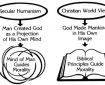 Christian Reply To Secular Humanism – Colossians 2:8
  Feed My Sheep
Leave a Reply!