Although this book is supposed to be fiction, it is being touted by many as a historically accurate, factual portrayal of early Christianity and the Catholic Church. This book is fiction about fiction! It attracts people with its promises of gnosis or “secret knowledge” about a number of topics. It also suggests that subjective individualism, not traditional religion, holds the real answers to life’s big questions. The novel is based on the belief that Jesus was a mere man, that Christianity is a despicable sham and that all claims to objective religious truth are to be avoided.
If people knew their church history and studied their bibles we wouldn’t need to be concerned about this book. However, many of the numerous errors in Brown’s books won’t be obvious to the general public. The majority of readers will accept the conspiracy theories and distortions of history, because they don’t know, for example, what the Gnostic gospels even are.
I have compiled a list of some of the errors found in the Da Vinci Code. It is by no means an exhaustive list, but it will give you an idea of the poor scholarship and unfactual content of Dan Brown’s books. Hopefully, it will also equip you with some of the information you will need to battle the revival of paganism that has, no doubt, been helped along by this book
1 – The Gospels are not the earliest books
This is an old Gnostic heresy. The truth is that there is less than 40 books written about Jesus. The Gnostic gospels that Brown relies on most heavily (The Gospel of Peter and the Gospel of Thomas) weren’t written until the second century A.D., long after the New Testament gospels were written. The New Testament was complete before the end of the 1st Century.
2 – The Dead Sea Scrolls were discovered in the 1950’s
There is nothing in the Dead Sea Scrolls that promotes either traditional or deviant Christianity. The community at Qumran responsible for the Scrolls was not Christian, but Jewish. The Scrolls were found in 1947 not the 1950s.
3 – The Dead Sea Scrolls and the Gnostic texts found at Nag Hammadi are the earliest Christian Records
The Dead Sea Scrolls are strictly Jewish documents. They don’t contain any gospels or anything even mentioning Jesus. There is also absolutely no evidence that any of the gnostic documents were written before the late second century AD.
4 – Jesus Christ never claimed to be divine and was never worshipped as a deity until the Council of Nicea in 325 A.D.
Jesus is called God (theos) seven times in the New Testament and is called Lord in the divine sense several times. Everyone knows that the texts of the New Testament predate the Council of Nicea, and that these were first century beliefs. A few examples are:-.
- Jesus said, “I and the Father are one” (John 10:30). He claimed to be nothing less than God in human flesh.
- Jesus claimed to be the “I AM” of the Old Testament (Matthew 14:22-23; Mark 6:45-52; Exodus 3:14).
5 – Christianity borrowed its beliefs from the pagan religion of Mithraism. Mithraism worshipped the pre-Christian God Mithras, called the Son of God and Light of the World, who was born on December 25th, died, was buried in a rock tomb, and then resurrected in three days
Scholars of Mithraism would strongly disagree with Brown on all of these points. Nowhere is Mithras given the title “Son of God” and the “Light of the World”. Brown apparently made this up because it sounded good. Mithras was born on the 25th December, however this proves nothing. The New Testament never associated December 25th with the birth of Christ. The early Christians chose to celebrate the birth of Christ on this day intentionally to oppose the pagan mid-winter festival of Saturnalia. They never claimed Jesus was actually born on that date. The claim that Mithras died and was buried in a rock tomb is just not true. Scholars will tell you that in Mithraism there is no death of Mithras at all. So, there was no rock tomb and no resurrection.
6 – Jesus was married to Mary Magdalene
The New Testament never mentions Jesus being married or even suggests it, so Brown uses one of the Gnostic gospels, the Gospel of Philip to support this claim. We only have fragments of the text he uses as his support and that text reads as follows:
“And the companion of the…Mary Magdalene…her more than…the disciples…kiss her…on her…” (Philip 63:33-36). Philip 58-59 seems to indicate that the kiss would have been on the lips. In 1 Corinthians 16, Paul mentions this kind of chaste kiss of fellowship, and this is likely what is meant here. However, we need not rest on that argument.
Marriage for Jewish men was not obligatory during Jesus’ time, nor has it ever been. Other single Jewish men you may know include Jeremiah, the wilderness prophet Banus, and John the Baptist. There’s no evidence in any historical records that Jesus was married.
7 – Christianity honored the Jewish Sabbath of Saturday, but Constantine changed the day to coincide with the pagan veneration day of the sun
It is clear that Christian observations were and always have been held on the “first day of the week” (Acts 20:7, 1 Cor. 16:2; cf. Rev. 1:10), and there is ample evidence of Sunday being observed well before Constantine.
8 – The “Secret of the Holy Grail”
This holy blood, according to Brown, descended from Jesus and his wife Mary Magdalene till today. Mary Magdalene was a woman from whom Jesus cast out seven demons (Luke 8:2). The name Magdalene likely indicates that she came from Magdala, a city on the southwest coast of the Sea of Galilee. After Jesus cast seven demons from her, she became one of His followers.
The earliest reference to a holy grail is from 1191/1202, and the whole idea is derived from Celtic myth, folklore, & other legends. There is no evidence whatsoever to support the belief that Jesus and Mary Magdalene were married. The Bible does not even hint at such an idea. Surely if Jesus had been married the Bible would have told us so.
9 – The conclusion
There are many more errors found in Brown’s book, but these should be sufficient to demonstrate that his scholarship is poor, his theories are not based on fact.
It’s important that Christians expose these kind of attacks on our faith, and imperative that we educate people on the true history and message of the Word of God. We have an advantage. Because our faith is built on God’s Word and on truth, we can depend on facts to present our case. We don’t have to resort to lies, conspiracy theories, and revisionist history.
Categories: Apologetics
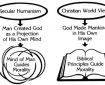 Christian Reply To Secular Humanism – Colossians 2:8
  Feed My Sheep
Leave a Reply!