It is estimated that around 13% of the world’s population are adherents to Hinduism. The vast majority of these live in India, around 700 million. Nepal is the only country where Hinduism is the state religion.
The origins of Hinduism can be traced back to around 1500 BC in what is now known as India. It began as a polytheistic and ritualistic religion. These rituals were at first simple enough to be performed by the head of the home. As it became more complex over the centuries it became necessary to create a priestly class to perform these rituals correctly.
While there are some core beliefs common to virtually all Hindus, there really is no hard and fast dogma that all Hindus must believe. It’s actually a family of gradually developing beliefs and practices. Hinduism appeals to Western culture as it is comfortable with evolutionary thinking, believes in the divine goodness of all, tolerates diverse religions and appeals to those disillusioned with strictly material pursuits.
Although Hinduism is tremendously diverse, most Hindus hold to the following beliefs:- .
1 – The Impersonal Nature of Brahman
Hindus see their ultimate reality Brahman as being an impersonal oneness that is beyond all distinctions, including personal and moral distinctions. The universe is seen by most Hindus as being continuous with and being extended by the Being of Brahman.
The Christian sees God as eternal, yet personal and distinct from His creation. This means that each person is personally responsible for their moral conduct. While God is perfect and holy, man has sinned and fallen short of God’s glory.
Hinduism lacks any understanding that God created this world for a good purpose. It is common for Hindus to speak of God bringing the universe into existence simply as a “playful” exercise of His power. Also lacking is a conception of God as infinitely holy and righteous and as the One to whom we as His creatures are accountable for the way we conduct our lives.
2 – The Law of Karma
According to Hinduism, humanity’s main problem is that we are ignorant of our divine nature. We have forgotten that we are extended from Brahman and have attached ourselves to the desires of our separate selves or egos and the consequences of our actions. The ego’s attachments to desires and individualistic existence means that this person becomes subject to the law of karma.
The law of Karma is the moral equivalent of the natural law of cause and effect. In essence, it says that we reap what we sow. The effects of our actions then follow us not only in the present lifetime but from lifetime to lifetime, which is why there is reincarnation. In the law of karma there is no possibility of forgiveness. Its consequences are inevitable and inescapable.
The law of karma has some validity in life. The Christian can accept that in this lifetime those who sin will personally reap the consequences of that sin, such as shame, a jail sentence or a failed marriage. See Galatians 6:7 – “A man reaps what he sows”.
However, sin often hurts others and most importantly it hurts God. David committed the sins of both murder and adultery and he wrote, “against you, you only, have I sinned” – Psalm 51:4. As a result of our sin, our fellowship with God is broken. It will continue to be broken until it has been resolved. While the bad news is that sin results in us being alienated from God, the good news is that with a personal God forgiveness is possible.
This forgiveness does have a price. Jesus paid this price on the cross. He was God come in the flesh and so represented the One who had been sinned against. He was sinless and so qualified to bear on our behalf the consequences of our sin, which was death. He paid for our “karma” in that He took the penalty of death that we deserved and paid it on our behalf. This forgiveness is available to all who trust and follow Him.
3 – Reincarnation (Samsara)
The word “Samsara” refers to the ever-revolving wheel of life, death and rebirth. Hindus believe that in this lifetime we reap the consequences of the deeds we committed in previous lifetimes. A person’s karma determines the kind of body – whether human, animal or insect – into which he or she will be reincarnated in the next lifetime.
Closely associated with the doctrine of reincarnation is that of “ahimsa” or “non-injury to living things”. This is the core moral value of Hinduism, the protection of all life (which is ultimately divine), and is the main reason why some Hindus are vegetarian.
The concept of reincarnation is widely accepted among non-Christians, probably because it appeals to many who would like to believe that they would be given a second chance in case they failed to make the grade in this life. Christianity disputes reincarnation because it is unnecessary, since anybody can “make the grade” simply through an act of their own will. The Bible is clearly opposed to reincarnation. For example:-
“And inasmuch as it is appointed for men to die once and after this comes judgment” (Hebrews 9:27).
“Then they will go away to eternal punishment, but the righteous to eternal life.” (Matthew 25:46).
Obviously, if a person dies only once, then he can’t be reincarnated. Other refutations of reincarnation came from Jesus. In His description of Lazarus the beggar and the rich man, Jesus indicated that the rich man was unable to do anything about his fate (eternal torment in Hell). Reincarnation is supposed to allow a person a second chance at heaven. Jesus, in His teachings, indicated that people would have only one chance to obtain eternal life, otherwise suffer eternal punishment. See Luke 16:19-31.
Why would God allow a second chance for those who made mistakes on their first attempt? God’s answer for salvation is quite simple. Salvation is a free gift for all who want it. It requires only repentance from your former life (admitting you were wrong and wish to change) and belief in the completed work of Jesus Christ on the cross to atone for your sins. Anyone can be saved through the gospel (good news) of Jesus Christ. Don’t expect a second chance to go to heaven. Today is the day of salvation! See 2 Corinthians 6:2.
4 – Moksha (Liberation) & the caste system
Also associated with reincarnation is the caste system. According to Hindu teaching, there are four basic castes or social classes (and thousands of sub-groups within the castes). Each has its own rules and obligations pertaining to nearly every facet of life:-
- At the top are the Brahmins or priests.
- Second in rank are the Kshatriyas or warriors and rulers.
- Third are the Vaisyas or merchants and farmers.
- Below these are the Shudras or labouring class. Salvation is possible only for the top three castes, who are called the “twice born.” Outside the caste system are the untouchables or outcasts. Though outlawed in India in the late 1940s, many in the countryside are still considered outcasts.
One’s caste is determined at birth by his or her own personal karma. Attempts, therefore, to bring about social change or to improve one’s social position would appear to run contrary to the law of karma and the caste system.
It’s little wonder that the chief aim of the Hindu is to experience release or liberation from this cycle of death and rebirth caused by karma. Hindus call this liberation moksha.
According to the Bible, however, our spiritual need is for deliverance from God’s judgment on our sin and for restoration to a life under His direction and care. This salvation can be provided only by God’s gracious and undeserved action in our behalf .
Categories: Apologetics
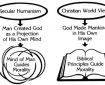 Christian Reply To Secular Humanism – Colossians 2:8
  Feed My Sheep
Leave a Reply!