The word “animism” comes from the Latin word “anima” which means “soul” or “breath”. Animism sees the physical world as interpenetrated by spiritual forces that can be personal or impersonal. So if there is an accident or if someone is sick, there are spiritual reasons for these things that must be understood if a remedy is to be found.
Strictly speaking, animism cannot be classified as a world religion as such because it is not a unified system. But animism tends to exhibit certain basic characteristics wherever one finds it. Most often one god is more prominent than the others, but attention is accorded to numerous deities, spirits, and powers. Prominent religious personages include priests, shamans, witch doctors, sorcerers, astrologers, and fortune tellers.
Fundamental features include sacrifices, witchcraft, magic, fetishes, amulets, talismans, augury, and the like. The basic motivation is fear. And the quest is not so much for the meaning of existence as it is for the maintenance of existence in a world of capricious spirits and opposing powers. It has been popularly thought that this kind of religion is confined to untutored and backward people, but the widespread resort to some of these practices in the Western world belies that thinking.
1 – One God among the many Spirits
They believe there is one Supreme Being who exists beyond the intermediate ancestors, spirits and gods. This God is can be either personal or impersonal but is either too far removed from His creation or to abstract to be known. This Supreme Being uses intermediate spirits to do his will and to serve as His representatives.
See Hebrews 1:1-3. “In times past, God spoke in partial and various ways to our ancestors through the prophets; in these last days, he spoke to us through a son, whom he made heir of all things and through whom he created the universe”.
Although God is beyond our comprehension, He is nevertheless knowable. He has made himself known to us through Jesus Christ and through the Bible. The God of the Bible uses angels to do some of his work. They may appear to people but they cannot be contacted by people. There are also evil spirits (demons) who masquerade as God’s agents. God is near and wants to be known. Psalm 46:1. “God is our refuge and strength, a very present help in trouble”.
2 – A division between ultimate and immediate issues in life
The formal religions such as Christianity, Islam and Hinduism are viewed as relevant with respect to ultimate issues such as who is God, what is humanity’s problem and what happens after death.
However, these religions are seen as unimportant when it comes to addressing the immediate issues of everyday life. This explains why an animist can be a practicing Catholic, but also consult a shaman (spiritualist) in order to be healed.
See 1 Peter 5:7 “Casting all your care upon him; for he careth for you”. The God of Christianity is concerned both with the ultimate and the immediate issues. God desires to provide not only for our eternal needs but also for our daily needs. Jesus wept when he heard about the death of Lazarus and brought him back to life. He spoke to the despised Samaritan woman at the well who had been married five times and changed her life. Jesus showed compassion for the adulterous woman who was about to be stoned and changed her life. Nothing is too big or too small for God to care about.
3 – A personal and impersonal spiritual realm
- Personal spirit beings – There are those that have been embodied (E.g. Deceased . ancestors) and those that had not. (E.g. Spirits and gods). These spirits will intercede to God on our behalf but they must first be given homage. They possess specific powers and cover a localised geographical area.
- Impersonal spiritual force – This holds that an impersonal spiritual energy infuses special objects, words or rituals. This energy gives these objects the power that people need to accomplish their desires.
The God of the Bible is God of all the earth and the universe. (Acts 17:24). Christianity teaches that the spirits are deceptive and seek to take the place of God in our lives. Satan is the “prince of this world” (John 12:31) and the “god of this age” (2 Corinthians 4:4). He is a natural-born liar. His evil nature is hidden by deception. He is cloaked in apparent beauty and in the promise of power. He has deceived humanity with his promise “you will be like God”. (Genesis 3:5). The deception continues through today. Satan’s plans are not for our good, but for our destruction. (John 8:44;10:10).
4 – A different concept of sin
Animists are more concerned with offending the local spirit than offending the supreme God. They reason that an offended spirit will exact retribution in the form of injury, sickness, failure or strife. Animists live in continual fear of these spiritual powers.
Christianity teaches that all have sinned and fallen short of the glory of God. See Romans 3:23. We realise that no one can keep the commandments of God perfectly which is why all people are deserving of damnation (Ephesians 2:3) and why we need a saviour. If righteousness can come through the Law, then Christ died needlessly (Galatians 2:21).
From a biblical perspective salvation is the working of God to reestablish his relationship with an alienated creation. Salvation has been initiated by Creator God; humankind cannot devise a substitute. Paul concisely describes God’s distinctive plan of salvation: “God made him who had no sin to be sin for us, so that in him we might become the righteousness of God” (2 Corinthians 5:21). God chose a perfect sacrifice, a divine offering without blemish, to be offered for the sins of humankind, an eternal expression of the love of God (John 3:16). People are saved by accepting this sacrifice of God, not by devising their own ways of propitiation and redemption.
5 – Contacting the spirits
An animist will tend to attribute spiritual causes for their sickness or bad fortune. Divination is used to discover how to resolve the problem. It may be that the spirit requires something or they should throw a counter-curse. However, divination can also be used to discover when it is the most fortuitous time to do things. E.g. Marriage.
See Colossians 2:15 – “And having spoiled principalities and powers, he made a shew of them openly, triumphing over them in it.” The spirits do have power, but our utilizing such power leads to bondage. God has demonstrated through Jesus Christ that He is greater than the spirits and magic. (1 John 4:4).
The Bible frowns on the practice of contacting the dead and other spirits. See Isaiah 8:19. “When men tell you to consult mediums and spiritists, who whisper and mutter, should not a people inquire of their God? Why consult the dead on behalf of the living?” See Leviticus 19:31 “Do not turn to mediums or spiritists; do not seek them out to be defiled by them. I am the LORD your God”. See also Luke 16:25-26. There is no contact with those who have died. It is all deception.
6 – A different concept of the afterlife
There is no consistent or universal doctrine throughout the many animistic religions as to what happens to a person after death. Many see the person’s spirit as continuing to exist after death either by being reincarnated into another life on earth or by “graduating” to a higher spiritual level.
The belief is also common that the person who dies becomes an ancestral spirit. The family must then continue to give offerings to that ancestor because it has the power either to protect or plague the family.
The Christian view is that clearly revealed in the Bible. There is no contact with the spirit world. This has been discussed in point 5 above. So what happens when someone dies? Hebrews 9:27 states, “Just as man is destined to die once, and after that to face judgment.” There is no endless cycle of reincarnation. We each have to face our maker.
The Christian experiences eternal life and a transformation. Philippians 3:20-21 says, “And we eagerly await a savior from there, the Lord Jesus Christ, who, by the power that enables him to bring everything under his control, will transform our lowly bodies so that they will be like his glorious body.” 1 John 3:2 promises, “But we know that when he appears, we shall be like him, for we shall see him as he is.”
The person who has rejected Christ will be judged and sentenced to hell. At the end of the age, he faces the Great White Throne judgment. Here, all the unrighteous dead from the beginning of time are judged based on their rejection of the Savior. They are then thrown into the lake of fire for eternity. See Revelation 20:11-15 says: “And I saw a great white throne and Him who sat upon it, from whose presence earth and heaven fled away, and no place was found for them. And I saw the dead, the great and the small, standing before the throne, and the books were opened; . . . and the dead were judged from the things which were written in the books, according to their deeds. . . . And if anyone’s name was not found written in the book of life, he was thrown into the lake of fire”.
No one wants to make this mistake. There is a God who cares and is very close. If you answer the door he will come in. You have nothing to fear if He is on your side. You have everything to fear without Him. There is no other way to Heaven.
Categories: Apologetics
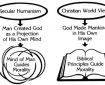 Christian Reply To Secular Humanism – Colossians 2:8
  Feed My Sheep
Leave a Reply!